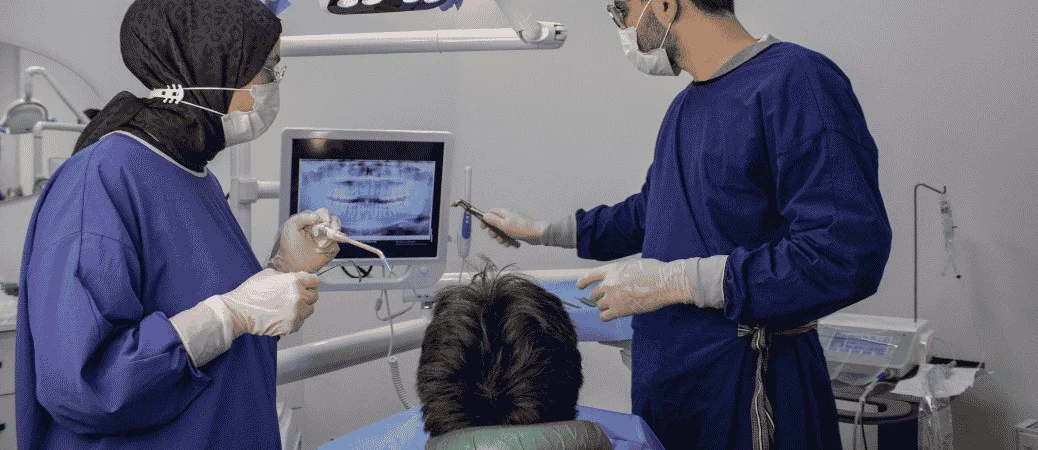
If you have diabetes and you are missing a tooth, you can still be a candidate for a dental implant.
Diabetes by itself does not rule out treatment. What shapes the real risk is how steady your blood sugar has been, whether your gums are healthy, how much bone supports the site, and how well your dental and medical teams talk to each other.
That is a relief for a lot of people who assume a diagnosis closes the door on tooth replacement.
Older dental writing treated diabetes as a reason to say no.
Current thinking is more careful: well-controlled diabetes is not a barrier to implant placement, while uncontrolled diabetes meaningfully raises failure risk, which is why your HbA1c number matters more than the diagnosis on your chart.
Managing diabetes already asks a lot of you every day. Adding surgery to that list deserves a plan you can follow, not a lecture.
If you’re considering dental implants with diabetes, understanding these factors before surgery can help you prepare for a safer healing process.
By the end of this article, you’ll know what your care team looks at before saying yes, what changes during healing, and which habits help protect your implant for years.
Key Takeaways
- Stable blood sugar, healthy gums, and enough jawbone matter more for implant candidacy than a diabetes diagnosis alone.
- High blood sugar slows bone and gum healing, so your timeline and follow-up schedule are usually longer.
- Daily cleaning and regular professional visits are what keep an implant healthy after the crown goes on.
Are You a Good Candidate for an Implant?
Implant candidacy comes down to four practical questions: is your blood sugar stable, are your gums free of active infection, does the jawbone at the site have enough volume and density, and do you smoke.
Type 1 diabetes, type 2 diabetes, and prediabetes do not automatically rule someone out for dental implants.
Controlled Diabetes vs. Uncontrolled Diabetes
Controlled diabetes means your blood glucose stays in your target range most days and your A1C has held steady for months.
Uncontrolled or poorly controlled diabetes means frequent high readings, big swings, or an A1C that has drifted upward.
That difference changes the biology of healing. With hyperglycemia, bone forms more slowly and white blood cells fight bacteria less effectively.
Poorly controlled diabetes does not mean “never.” It usually means “not yet.” Several months of tighter blood sugar management can move you into a much safer window, and many people do exactly that before surgery.
How A1C and Daily Blood Glucose Guide Timing
Your HbA1c is a three-month average of your blood sugar, so it tells your surgeon how your body has been running, not just how today went.
Your dental and medical teams may review your HbA1c and recent blood glucose patterns before surgery. There is no single HbA1c cutoff that determines implant candidacy for every patient.
Treat these numbers as clinical guideposts, not guarantees.
A single A1C test does not decide your case, and daily glucose logs often tell your team more, because a smooth pattern of readings is easier to heal on than an average that hides big spikes and lows.
Other Factors That Affect Implant Candidacy
Smoking is another important factor that may affect implant candidacy because it can interfere with blood flow and healing.
It narrows blood flow to the gums and jaw, and stacked on top of elevated blood sugar it raises the chance of early failure.
Gum health comes next. Active periodontal disease around neighboring teeth seeds bacteria into a fresh surgical site, so treating gum disease before implant surgery is standard practice.
Bone quality and density decide whether the implant has something solid to hold.
When years of tooth loss have thinned the ridge, dental implants with bone loss are still possible with grafting, just on a longer timeline.
Bring questions about all of this to your consultation; a good list of questions to ask your dentist about getting dental implants helps you get honest answers.
Why Diabetes Can Change Implant Healing
Diabetes affects healing in three places that matter for implants: how fast bone grows onto the implant surface, how quickly gum tissue closes over the site, and how well your immune system holds bacteria in check.
Elevated blood sugar slows all three, which is why your team plans a longer, more closely watched recovery.
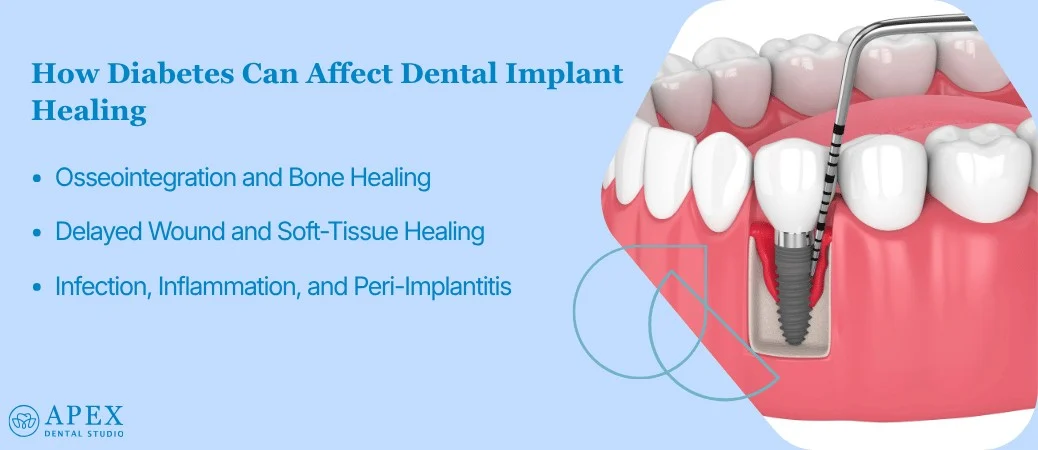
Osseointegration and Bone Healing
Osseointegration is the process where your jawbone grows directly onto the titanium surface and locks the implant in place. It is what turns a post into a functioning tooth root.
High blood sugar changes bone metabolism. Bone-building cells work more slowly, and the new bone that forms can be less dense at first.
The practical effect is time. Instead of a standard three to four months of healing, your surgeon may allow five or six before loading the implant.
Rushing this stage may interfere with proper osseointegration and implant stability.
Delayed Wound and Soft-Tissue Healing
Gum tissue over the implant also closes more slowly when glucose runs high. Elevated blood sugar delays the body’s ability to repair tissue after surgery, which stretches out the whole healing window.
Dry mouth adds to the problem, since saliva is your natural rinse. Many diabetes medications reduce saliva flow, leaving tissue more vulnerable while it knits together.
You will notice this as sutures that stay a bit longer and swelling that takes a few extra days to settle. The dental implant recovery timeline shifts, and that shift is expected, not a sign something went wrong.
Infection, Inflammation, and Peri-Implantitis
High glucose gives oral bacteria more fuel while your immune response is working at a disadvantage. That combination raises infection risk in the weeks after surgery.
Later on, the concern becomes peri-implantitis: inflammation of the gum and bone around an implant that has already healed. Left alone, it causes bone loss and eventually implant failure.
Peri-implant inflammation starts quietly. Bleeding when you clean around the implant is the earliest signal worth reporting, well before anything feels loose.
How to Prepare Safely for Implant Surgery
Preparation is where you have the most influence over the outcome, and it usually starts two to six months before the surgical date.
Your job during that window is to get your glucose steady, get your gums healthy, and make sure everyone treating you shares the same plan.
Coordinate Your Dental Provider and Diabetes Care Team
Ask your dental provider to send a short note to your primary care physician or endocrinologist before scheduling. It should cover the planned procedure, expected healing time, and any request for recent lab work.
A team approach works best: your physician manages blood sugar, an oral surgeon or periodontist places the implant, and a prosthodontist or restorative dentist designs the crown.
General dentists then handle long-term maintenance.
At Apex Dental Studio, Dr. Andy Tran, DMD, MBA, can evaluate your oral health, review factors that may affect implant healing, and help determine whether dental implants are appropriate for your situation.
Treat Gum Problems and Plan for Bone Grafting
Any bleeding gums, deep pockets, or loose teeth get treated first. Periodontal therapy before implant surgery lowers the bacterial load in your mouth and gives the new site a cleaner start.
If a tooth still needs to come out, healing from a tooth extraction takes priority before any implant is placed.
Thin or soft bone often calls for grafting, which adds three to six months to the schedule.
Grafting and implant placement are both handled through oral surgery, sometimes at the same appointment and sometimes in stages, depending on how much bone you have.
Medication, Meals, and Day-of-Surgery Blood Sugar
Never change a diabetes medication on your own before surgery. Ask specifically about insulin dosing, metformin, and SGLT2 inhibitors, since some are adjusted or held around procedures.
Book a morning appointment when possible, eat your normal breakfast unless told otherwise, and bring your meter plus fast-acting glucose.
Local anesthetic lets you eat before and after, which keeps your levels far more predictable.
Bring these to your surgical visit:
- Your glucose meter or CGM reader
- A current medication list with doses
- Fast-acting glucose (juice, tabs, or gel)
- Soft foods for the first 48 hours at home
- Your physician’s contact information
What Happens During Surgery and the Healing Period?
Implant surgery itself looks the same whether or not you have diabetes: local anesthetic, a small opening in the gum, a precisely drilled channel, and a titanium implant placed into the jawbone.
The differences show up in pacing, in how bacteria are managed, and in how often you are seen afterward.
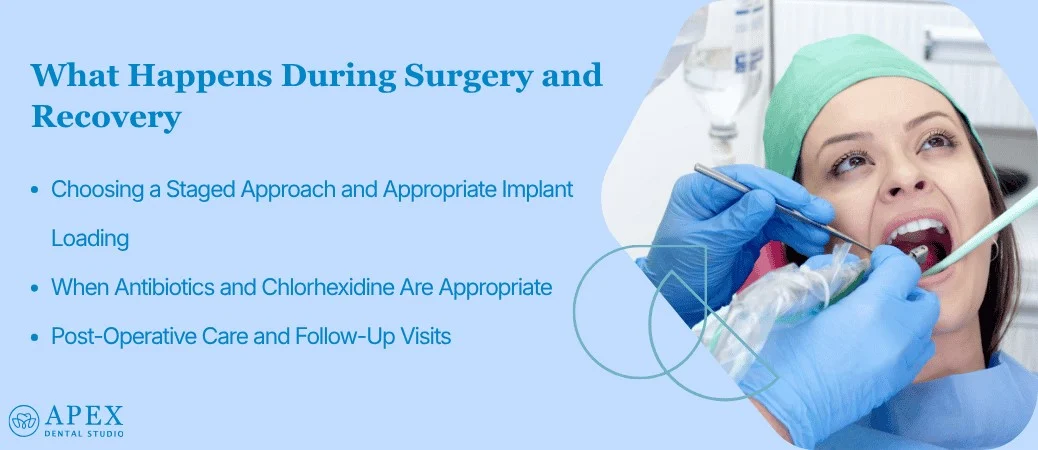
Choosing a Staged Approach and Appropriate Implant Loading
A staged approach is the safer default. The implant goes in, heals under the gum for several months, and the crown is attached only after bone has locked it in place.
Depending on blood sugar control, bone quality, implant stability, and other health factors, your surgeon may recommend a staged approach rather than immediate loading.
You may wear a temporary tooth in the meantime.
For a single dental implant this feels slow, and it is worth it. A walk through the dental implant process helps set that timeline in your mind before you start.
When Antibiotics and Chlorhexidine Are Appropriate
Antibiotics are not automatic for every patient with diabetes. Your surgeon decides based on your glucose control, the extent of surgery, whether grafting is involved, and your infection history.
Prophylactic antibiotics before placement and a short course afterward are common in higher-risk cases.
The American Dental Association supports targeted use over routine prescribing, and that judgment belongs to the person doing your surgery.
Chlorhexidine mouthwash is prescribed more often. A short rinse regimen lowers bacterial counts while you cannot brush the site normally, and it is easy to keep up.
Post-Operative Care and Follow-Up Visits
Check your blood sugar more often for the first week, since surgical stress and a softer diet both nudge your numbers around. Keep a written log and share it at your first follow-up.
Expect more appointments than a patient without diabetes. Many surgeons add a visit at one week, three weeks, and again before the crown goes on, so delayed healing gets caught early instead of late.
Call promptly for fever, spreading swelling after day three, drainage, or a bad taste. Those signs are treatable when reported early.
How to Protect Your Implant for the Long Term
An implant that has healed well can serve you for decades, and the daily habits you keep are what decide that.
Survival (the implant is still there) and success (healthy bone, calm gums, no ongoing bone loss) are two different measures, and your home care and cleaning schedule move both.
Daily Oral Hygiene and Professional Dental Cleanings

Brush twice a day and clean between the implant and neighboring teeth every day with floss, an interdental brush, or a water flosser. Bacteria collect at the gumline first.
Professional cleanings every three to four months are common for patients with diabetes, more frequent than the standard six months.
Hygienists use instruments safe for implant surfaces and can spot early inflammation you cannot see.
Practical guidance on caring for dental implants covers the tools worth owning, and the Apex Dental Studio hygiene team can show you the technique that fits your restoration.
Watch for Peri-Implantitis and Bone Loss
Report bleeding, tenderness, redness, or pus around the implant right away.
Peri-implantitis caught in its inflammatory stage often responds to cleaning and improved home care, while established bone loss is much harder to reverse.
A shifting or slightly mobile crown deserves an urgent call. There are several reasons dental implants come loose, and most are fixable when addressed quickly.
Keeping your A1C in your target range remains part of implant care years after the surgery, because the same biology that affects healing also affects long-term gum and bone stability.
Implants vs. Dentures for Replacing Missing Teeth
Dentures stay a reasonable choice when blood sugar is hard to stabilize or bone volume is limited. They avoid surgery entirely, and they can be upgraded later.
| Dental implants | Conventional dentures | |
| Surgery needed | Yes | No |
| Healing time with diabetes | 5 to 6+ months | None |
| Preserves jawbone | Yes | No |
| Requires stable A1C | Yes | Not required |
| Daily cleaning around gumline | Yes | Removed and cleaned |
Implant-supported dentures sit between the two options and use fewer implants than replacing every tooth.
Reading through the pros and cons of implant-supported dentures helps you weigh cost, comfort, and surgical load against a removable plate.
Stable Diabetes Management Creates the Best Conditions for Implant Success
Glycemic control is the thread running through every stage of this process. It shapes whether you are cleared for surgery, how long osseointegration takes, and how your gums behave around the implant five years later.
Diabetes and dental implants work together when the pieces are in place: an A1C that has held steady, gums treated before placement, enough bone or a graft plan, no smoking, and a schedule of cleanings you keep.
Implant survival in well-controlled patients tracks closely with patients who do not have diabetes.
If your numbers are not there yet, that is a timing conversation and not a rejection. Book a consultation, get an honest read on your gums and bone, and give yourself a few months to prepare with your physician’s help.
The team at Apex Dental Studio can look at your case and tell you where you stand today.
Frequently Asked Questions
Can I get dental implants if I have diabetes?
Yes, in most cases, as long as your blood sugar is reasonably stable and your gums are healthy.
Your dental team will review recent lab work, check for gum disease, and evaluate the bone at the site before recommending dental implants.
Poor control usually delays treatment rather than ruling it out permanently.
What HbA1c level is usually needed before dental implant surgery?
Most surgeons want an HbA1c under 7% to 7.5%, and readings above 8% within the past year typically prompt a specialist referral and more preparation time.
These are clinical guideposts, not fixed cutoffs. Your daily glucose logs, gum health, and smoking status all factor into the final decision.
Does type 2 diabetes make dental implant failure more likely?
Type 2 diabetes raises risk mainly when blood sugar is poorly controlled, not simply because of the diagnosis.
Well-managed patients see outcomes close to those without diabetes. Longer healing periods and extra follow-up visits are the usual adjustments to keep that risk low.
Can I get dental implants if I have bone loss from gum disease?
Often yes, though gum disease must be treated first and bone grafting is usually needed to rebuild the site. That adds three to six months before the implant is placed.
Your surgeon will measure bone height and width with a 3D scan to confirm what is possible.
Are All-on-4 dental implants an option for people with diabetes?
All-on-4 can work with well-controlled diabetes, though the immediate-loading part of the concept is often modified to allow longer healing.
Comparing All-on-4 vs traditional implants with your surgeon helps clarify which approach suits your bone and glucose control. A staged plan is the more cautious route when healing is slower.