If you’re an adult thinking about fixing your bite, you may not love the idea of years in metal braces. Good news: there’s another option that works alongside your treatment.
The Carriere Motion appliance is a head start that corrects your bite, often in three to six months, which can shorten your total treatment time.
Traditional braces move your teeth and correct your bite at the same time, which can take longer. The Carriere Motion Appliance handles the bite part upfront, then braces or clear aligners finish the job of straightening.
This small device attaches to your teeth and gently moves your upper molars backward, no headgear required.
Some practices report that patients shorten their overall treatment by about six months, though your results depend on your specific malocclusion.
When comparing a Carriere appliance vs braces, it helps to understand that each plays a different role in correcting your bite and improving your smile.
If your goals also include improving the overall appearance of your teeth, your treatment plan may incorporate cosmetic dentistry after your bite and alignment have been addressed.
Below, you’ll learn how each option handles common bite issues, what daily life looks like with the appliance, and how to decide what fits your goals.
Key Takeaways
- The Carriere appliance corrects your bite first, then braces or aligners straighten your teeth.
- Traditional braces handle both jobs at once, which usually means a longer timeline.
- Your best plan depends on your bite type, comfort preferences, and orthodontist’s assessment.
Table of Content
- How the Carriere Motion Appliance Corrects an Adult Bite
- What Traditional Braces Do Differently
- Which Adult Bite Problems May Benefit Most
- Treatment Timeline, Comfort, and Day-to-Day Care
- Combining Carriere With Invisalign or Braces
- Choosing the Right Adult Treatment Plan
- Frequently Asked Questions
How the Carriere Motion Appliance Corrects an Adult Bite
The Carriere Motion Appliance works on your back teeth first, sliding your molars into the right spot before a single bracket goes on the front teeth.
It uses small elastic bands, a metal or clear bar on each side of your mouth, and your own jaw movement to shift the bite forward or backward.
The Sagittal-First Approach
Sagittal just means front-to-back. So sagittal correction is about fixing how far forward or backward your upper teeth sit compared to your lower teeth.
Most traditional treatment straightens teeth first and fixes the bite later. The Carriere flips that order and puts the hardest part first, while your teeth are still unbracketed and free to move.
There’s a practical reason for this. Loose, unattached teeth respond faster than teeth locked into a full archwire.
Once your molars and canines line up, braces or aligners handle the rest.
Appliance Placement, Elastics, and Anchorage
The device itself is a slim bar that runs along the outside of your teeth, from your canine to your first molar.
Your orthodontist bonds one on each side with dental adhesive. It comes in clear or metal finishes, so it can be fairly discreet.
Each bar has a ball joint at the canine end and a rotating pad at the molar end. That design lets your molars tip, rotate, and slide as a unit.
Now the part that depends on you: elastics. You hook a small elastic band from the appliance to an anchor on your lower arch, usually a custom retainer, a lingual arch, or a temporary anchorage device.
Anchorage matters because every force has an equal push in the other direction. A solid lower anchor keeps that push from crowding your lower front teeth.
You’ll wear the elastic bands about 22 hours a day, taking them out only to eat and brush. Results depend on that commitment more than anything else.
What Changes During Class II and Class III Correction
The same appliance handles both bite types. The direction of the elastic force changes, and so does the result.
| Class II (overbite/overjet) | Class III (underbite) | |
| Where the bar goes | Upper teeth | Lower teeth |
| Main movement | Upper molars shift back and rotate | Lower molars shift back |
| Also happens | Lower jaw comes forward slightly | Upper arch moves forward slightly |
| Visible change | Overjet reduction, flatter profile change | Front teeth meet more evenly |
In a Class II case, your upper molars move backward while your canines come along with them. Your lower jaw often settles into a more forward position at the same time.
Class III correction runs the other way. The bar sits on the lower arch and walks those molars back.
Treatment with the appliance usually lasts three to six months, though your case may run shorter or longer. After that, braces or clear aligners finish the job with a bite that’s already in the right place.
What Traditional Braces Do Differently
Braces work on every tooth at once, moving crowns and roots into position while also fine-tuning how your upper teeth and lower teeth meet.
That full-mouth control is why full braces still handle crowding, rotations, and final bite details that a bite corrector alone can’t finish.
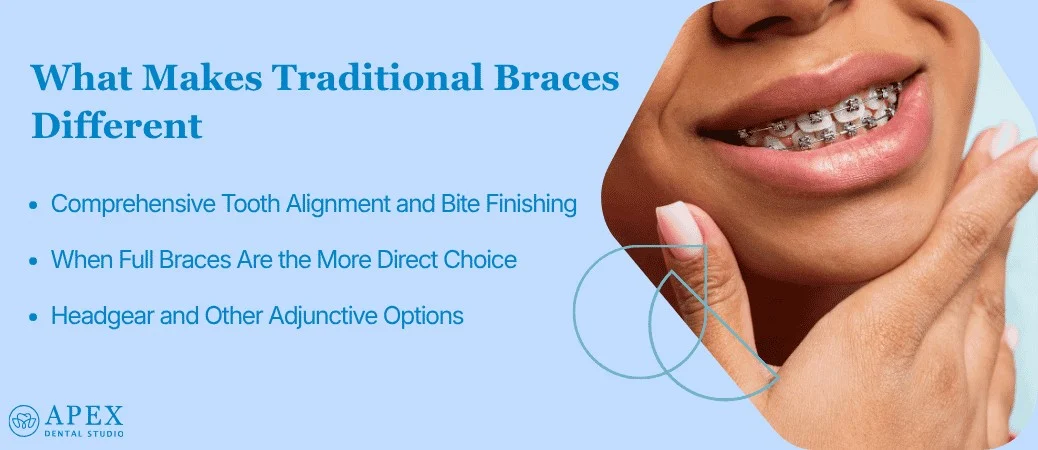
Comprehensive Tooth Alignment and Bite Finishing
Each bracket is bonded to a single tooth, and the archwire connects them all. That setup lets your orthodontist control tip, torque, and rotation on individual teeth.
Elastics, springs, and wire bends then settle the bite so your back teeth fit together evenly. This finishing stage matters for chewing comfort and long-term stability.
Traditional braces treatment usually takes 18 to 24 months on average, depending on how much movement you need.
Braces are also good at jobs a bite corrector doesn’t do:
- Closing gaps and extraction spaces
- Straightening severely rotated teeth
- Correcting deep bites and open bites
- Leveling uneven gum lines
When Full Braces Are the More Direct Choice
Sometimes skipping straight to braces makes more sense than adding a separate first phase.
Here’s when that’s often true:
| Your situation | Why braces first works |
| Mild bite issue, heavy crowding | Space and alignment are the real problem |
| Missing or extracted teeth | Wires and springs manage space closure |
| Loose or few anchor teeth | A bite corrector needs solid teeth to push against |
| You want one appliance start to finish | Fewer appointments and transitions |
Bite correctors like the Carriere system are designed to hand off to a bracket system afterward, so treatment still moves into brackets either way. If your malocclusion is mild, that extra step may not save you time.

Headgear and Other Adjunctive Options
Braces are often paired with extra appliances when the jaws don’t line up.
Headgear attaches outside the mouth and holds back upper molar growth or pulls molars backward.
It works, but it usually requires 10 to 14 hours of wear each day, which is a lot to ask of an adult with a job and a social life. It’s often described as the traditional option that newer bite correctors replaced.
Other tools your orthodontist may use alongside braces include:
- Distalizers and pendulum appliances to move molars back and create space
- Temporary anchorage devices (TADs); small screws that give wires something firm to push against
- Rubber band elastics you hook between upper and lower brackets
- Extractions or jaw surgery for larger skeletal differences
Which Adult Bite Problems May Benefit Most
The Carriere appliance was designed mainly for bite correction, not general tooth straightening, so it fits some adult cases much better than others.
It works best when your back teeth need to shift into a better relationship before braces or aligners take over, and it has limits when your jaw bones themselves are the main problem.
Class II Malocclusion and Overbite
A Class II malocclusion means your lower jaw and lower molars sit too far back compared to your upper teeth. This is the classic overbite, and it’s the case the appliance was built for.
The device, also called the Carriere Distalizer, attaches to your upper canine and molar on each side. Light elastic force then guides those upper back teeth backward while the lower arch comes forward.
Because this happens at the start of treatment, your bite is often close to correct by the time brackets or aligners go on.
For some adults, this reduces the need for headgear, extractions, or more complex procedures later in the plan.
If your overbite is mild to moderate and mostly about tooth position, you’re likely a strong candidate.
Class III Malocclusion and Underbite
With a Class III malocclusion, your lower teeth sit ahead of your upper teeth, creating an underbite. The appliance can be used here too, just flipped in direction.
In these cases, it’s bonded to the lower arch instead. The elastics pull the lower molars and canines backward, which helps reduce the underbite before the main phase of treatment.
Manufacturers and orthodontists list the appliance as suitable for both overbite and underbite correction, and mild adult underbites often respond well.
That said, underbites in adults are more likely to be skeletal. If your lower jaw is genuinely too long, tooth movement alone won’t fix the look of your profile, and jaw surgery may still be part of the conversation.
Crossbite, Open Bite, and Skeletal Concerns
Other bite issues sometimes improve alongside the main correction. Orthodontists have used the appliance to help with crossbite, open bite, and TMJ-related complaints, usually as one part of a larger plan rather than a standalone fix.
Here’s a rough guide to how adult cases tend to sort out:
| Your situation | Likely fit |
| Mild to moderate Class II, teeth-based | Good candidate |
| Mild Class III, teeth-based | Often workable |
| Single-tooth or dental crossbite | May help as part of treatment |
| Severe skeletal mismatch | Braces plus jaw surgery more likely |
| Open bite from tongue habits | Needs added treatment |
Adults no longer have growing jaws, so early bite correction in teens usually produces bigger changes. That doesn’t rule you out, but it does mean your results depend more on moving teeth than reshaping bone.
A specialist orthodontist should take X-rays and scans first. That exam tells you whether your problem sits in your teeth, your jaws, or both, and that answer shapes everything that follows.
Treatment Timeline, Comfort, and Day-to-Day Care
Bite correction with the Carriere Motion Appliance usually happens in a short first phase, followed by braces or aligners to straighten your teeth.
Your daily habits during that first phase, especially wearing your elastics, have a big effect on how quickly things move.
Expected Phases and Treatment Duration
Your treatment is split into two clear parts. First, the appliance shifts your upper back teeth and molars into a better position. Then braces or clear aligners finish the alignment work.
Reported timelines for the first phase vary by practice and by case:
| Phase | Typical length |
| Carriere Motion Appliance | About 3–4 months in simpler bite cases |
| Carriere Motion Appliance | Around 6 to 8 months for more involved cases |
| Braces or aligners after | Usually 12–18 months |
Traditional braces alone often run 18 to 24 months, and correcting the bite up front can trim time off the total. Adults with denser bone sometimes need the longer end of that range.
Why Elastic Wear and Follow-Up Visits Matter
The appliance itself does not move teeth on its own. The force comes from small elastic bands that stretch from the appliance to a lower anchor, usually a molar band or a lower aligner hook.
Most orthodontists ask for 22 hours of elastic wear per day. You take them out to eat and brush, then put fresh ones in right away.
Skipping elastics is the main reason this phase stretches out. A few missed days can undo progress, since the teeth slowly drift back.
Plan on check-ups every 6 to 8 weeks. Your orthodontist measures how far the Class II or Class III correction has come, checks the bonding, and gives you more elastics.
Eating, Brushing, and Oral Hygiene
The appliance sits along the outside of your upper teeth, so your tongue barely notices it. Expect some soreness for the first three to five days, plus a little cheek rubbing while your mouth adjusts. Orthodontic wax helps.
Food rules are simpler than with full braces, since fewer teeth are bonded:
- Skip hard candy, ice, nuts, and sticky caramel
- Cut up apples, carrots, and corn on the cob
- Go easy on chewy bread and bagels
For oral hygiene, brush after meals with the bristles angled at the bonded pads. An interdental brush or floss threader clears the space under the appliance bar.
Rinse your elastics away from the sink drain, and keep a spare pack in your bag.
Combining Carriere With Invisalign or Braces
The Carriere appliance isn’t a standalone fix; it handles your bite first, then hands things off to Invisalign or braces to straighten your teeth.
This two-step order is what makes the whole plan work, and it changes how long you spend in treatment.
Transitioning to Invisalign Aligners
Your orthodontist places the Carriere Motion appliance on the outside of your upper teeth, usually with small elastics you hook to your lower jaw.
During this stage, you can wear your lower Invisalign aligners at the same time, so your bottom arch keeps making progress.
Once your bite reaches a Class I position, the appliance comes off. Then your upper clear aligners start.
At the finish line, both the aligner attachments and any brackets tied to the Carriere appliance are removed.
Using the Appliance Before Full Braces
If braces are your plan, the appliance still goes first. Fixing your bite before brackets are bonded means there are no competing forces from other appliances working against the movement.
Bite correction alone often runs about 3 to 7 months.
After that, full braces go on all your teeth to close spaces, level your arches, and detail the fit.
The Carriere system pairs with self-ligating brackets, and one combination of Carriere SLX braces with the distalizer treats mild to moderate Class II cases in roughly six months of appliance wear.
Benefits and Limits of a Two-Phase Plan
Here’s what you gain and what to keep in mind:
Benefits
- Bite work happens early, when your motivation is highest
- Total treatment time can drop by several months
- Adults who don’t want visible braces can correct an overbite before starting Invisalign
Limits
- Your upper teeth may feel sore while the appliance is active
- Elastic wear is on you; skipping them stalls progress
- Straightening still needs a second phase; the appliance doesn’t align teeth
- Severe skeletal problems may still call for other options
Choosing the Right Adult Treatment Plan
Your bite, your gum health, and your daily habits all shape whether the Carriere appliance, traditional braces, or clear aligners make sense for you.
A short exam and a few good questions can save you months of guesswork.
Factors That Affect Candidacy and Predictability
The Carriere appliance works best when your back teeth can move backward freely and your molars have solid support. That means a few things need to be in good shape first.
Your orthodontist will look at:
- Type of malocclusion: Class II (upper teeth ahead) or Class III (lower teeth ahead), and how many millimeters off your bite sits
- Gum and bone health: Active gum disease or bone loss limits how much force your teeth can safely handle
- Missing or crowded teeth: Space matters for the biomechanics of molar rotation and uprighting
- Elastic wear: The appliance depends on you wearing elastics most of the day, every day
Adults with mild to moderate bite mismatches tend to see the most predictable results. Severe skeletal differences respond less well, since traditional braces offer more precise control for complex movements.
When Surgery or Other Treatment May Be Needed
Not every bite problem is a tooth problem. If your upper and lower jaws are different sizes or sit in very different positions, moving teeth alone won’t fix the mismatch.
In those cases, your orthodontist may recommend orthognathic jaw surgery paired with braces. This is more common with large open bites, strong underbites, or noticeable facial asymmetry.
Other situations that change the plan:
| Situation | Likely approach |
| Severe skeletal Class III | Braces plus jaw surgery |
| Untreated gum disease | Periodontal care first, then orthodontics |
| Worn or broken teeth | Restorative work alongside bite correction |
| Jaw joint pain | Evaluation before force is applied |
Some adults are told the Carriere Motion appliance can replace surgery in certain moderate cases. Ask for a clear explanation of why that applies to your specific bite.
Questions to Ask Your Orthodontist
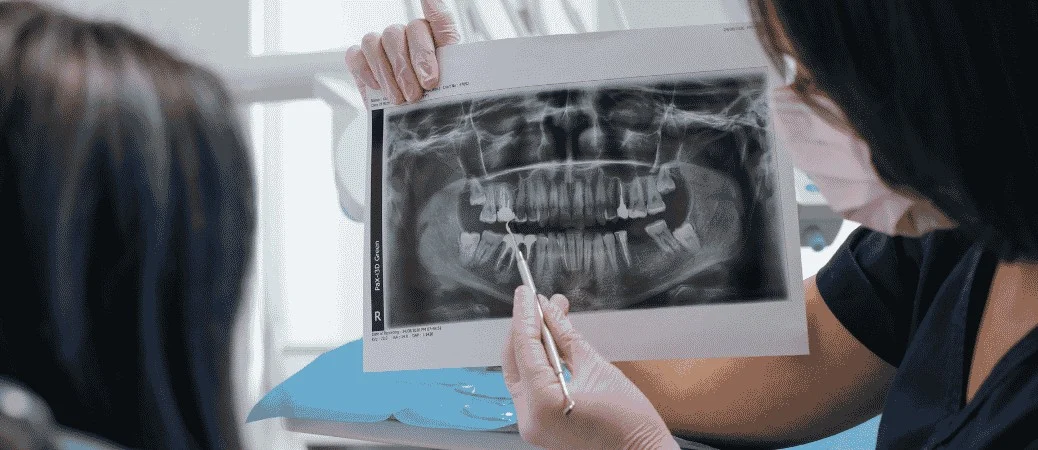
Bring a short list to your consultation. Good answers should be specific to your scans and X-rays, not general.
Worth asking:
- Am I a Class II or Class III case, and by how much?
- How many months would the Carriere phase last, and what follows it — braces or aligners?
- What happens to my treatment time if I don’t wear the elastics enough?
- Would you treat this case with braces alone, and how would the timeline compare?
- Is a specialist orthodontist handling every phase, or a general dentist?
- What retainer plan keeps the correction stable afterward?
Ask about the total cost and what insurance covers, since a two-phase plan is billed differently by different offices. Many practices also list financing options and in-house lab support that affect what you pay each month.
Frequently Asked Questions
Adults thinking about a Carriere Motion Appliance usually want to know how many months it adds, whether it beats braces alone, and what daily wear feels like.
Here are clear answers about treatment time, bite types it handles, elastics, and how it stacks up against a Herbst.
How long does the Carriere Motion Appliance usually take to correct an adult bite?
Most people wear the appliance for about three to six months. Some cases run a little longer, closer to seven months, depending on how far the bite needs to shift.
Adults often take a bit more time than teens because adult bone remodels more slowly. Your orthodontist will check your progress every four to six weeks and adjust the elastics as needed.
After the bite is corrected, you move into braces or clear aligners to straighten the teeth. The appliance handles the foundation first, not the fine details.
Is the Carriere Motion Appliance faster than traditional braces for adults?
It is not a replacement for braces, so think of it as a head start rather than a shortcut.
Working on the bite first, before brackets are bonded, can shorten overall treatment time by up to seven months compared to older methods.
The reason is simple. With no brackets or wires in the mouth yet, there are no competing forces pulling teeth in different directions.
Can adults use a Carriere appliance to fix an overbite, underbite, or crossbite?
Yes for many overbites and some underbites. The appliance is designed for Class II and Class III bite problems, which are the technical terms for upper teeth sitting too far forward or lower teeth sitting too far forward.
Crossbites are a different issue. A crossbite involves teeth that are too narrow or tipped sideways, so it usually needs an expander, braces, or aligners instead.
Severe skeletal problems in adults may still need jaw surgery. Your orthodontist will take X-rays and scans to tell you which group you fall into.
What is the difference between a Carriere Motion Appliance and a Herbst appliance?
A Herbst appliance uses metal rods and tubes that connect the upper and lower jaws, and it is cemented in place. It works well for growing kids but feels bulky and limits how wide you can open.
The Carriere appliance is a small bar bonded to the outside of your upper teeth, from the canine back to the first molar.
Elastics connect it to your lower arch, and the low-profile design is more discreet than most functional appliances.
Do you need to wear rubber bands with a Carriere appliance?
Yes, and this part matters more than anything else. The elastics run from a hook on the appliance to an anchor on your lower teeth or a lower aligner, and they supply the force that moves your molars.
You wear them roughly 22 hours a day, taking them out only to eat and brush. You swap in fresh ones at least once a day because rubber loses its stretch.
Skipping them stalls your progress. Results depend heavily on staying committed during treatment, so build the habit early.
What should adults expect before and after treatment with a Carriere Motion Appliance?
Before you start, you get records taken: photos, X-rays, and a digital scan. Bonding day takes about 20 to 30 minutes, and there is no drilling or numbing involved.
The first week is the adjustment period. Expect some soreness in your molars, a little cheek irritation until the tissue toughens up, and a slight lisp that fades fast. Softer foods help.
Afterward, your back teeth meet in a Class I position, which means the bite lines up properly. Correcting that foundation early means fewer surprises once braces or aligners go on.
The appliance comes off in one short visit, and braces or aligners usually start the same day. From there, you finish aligning the individual teeth with a bite that is already in the right spot.