If you are thinking about replacing all your teeth, you likely want a clear answer before you move forward.
A full mouth restoration with dental implants can rebuild your smile, but the number of implants you need depends on your bone, goals, and the type of teeth you choose.
Most full mouth restorations require between 4 and 8 implants per jaw, though some cases may need more for added support.
Some people qualify for dental implants options like All-on-4, while others need six or more implants for better strength, especially in the upper jaw.
Your dentist will check your jawbone, bite, and overall health before making a plan. When you understand how many implants you may need and why, you can feel more confident about your next step.
Key Takeaways
- Most full mouth restorations use 4 to 8 implants per jaw.
- Bone density and restoration type affect the number of implants.
- A custom treatment plan determines the right solution for you.
Schedule your full mouth dental implant consultation in Hutto, TX today.
Understanding Full Mouth Restoration With Implants
Full mouth restoration with dental implants replaces most or all of your teeth using secure, long‑term solutions. You regain chewing strength, protect your jawbone, and improve daily comfort compared to loose options.
What Is Full Mouth Restoration?
Full mouth restoration rebuilds or replaces all teeth in your upper jaw, lower jaw, or both. Dentists use a mix of treatments such as dental implants, crowns, bridges, and implant-supported dentures to restore function and appearance.
When you choose full mouth dental implants, your dentist places titanium posts into your jawbone. These posts act as artificial tooth roots. Over time, the bone bonds to the implants, which helps keep them stable.
The number of implants depends on your needs. Some full-arch treatments use four to eight implants to support a fixed set of teeth. In more complex cases, a full-mouth crown and bridge plan may use 12 to 16 implants.
Your dentist checks your bone level, bite force, and oral health before building a plan. The goal is to restore strong chewing, clear speech, and balanced jaw support.
Benefits of Dental Implants for Tooth Replacement
Dental implants support full mouth restoration in a way that closely mimics natural teeth. Because the implant sits in your jawbone, it helps prevent bone loss that often follows tooth loss.
You can bite and chew with more strength compared to removable dentures. Many patients prefer implant-supported options like All-on-X or overdentures, which use two to four implants per arch for support.
Key benefits include:
- Stable fit that does not shift while eating
- Better jawbone support
- Improved comfort with no adhesive needed
- Natural look and feel
With proper care, dental implants can last many years. You brush and floss them much like natural teeth, which supports long-term oral health.
Implants vs. Traditional Dentures
Traditional dentures rest on top of your gums. They replace missing teeth, but they do not replace the tooth roots.
Without roots, your jawbone slowly shrinks. This change can cause dentures to loosen over time. You may need relining or replacement to maintain fit.
Implant-supported dentures anchor to dental implants placed in your jaw. Even two to four implants can greatly improve stability. Fixed implant bridges stay in place at all times and do not come out at night.
Main differences:
| Feature | Traditional Dentures | Implant-Supported Options |
| Stability | Can shift or slip | Secure and anchored |
| Bone Support | Does not prevent bone loss | Helps preserve jawbone |
| Comfort | May rub on gums | Feels more like natural teeth |
| Removal | Removable | Removable or fixed |
If you want a tooth replacement option that protects your oral health and feels steady while eating, dental implants often provide more reliable support than traditional dentures.
Visit Apex Dental Studio in Hutto, TX to find out how many implants you need for a full smile.
How Many Implants Are Needed for Full Mouth Restoration?
You do not need one implant for every missing tooth. In most cases, your dentist uses a small number of dental implants to support a full set of teeth. The exact number of implants needed depends on your bone strength, jaw shape, and the type of teeth you choose.
Typical Number of Dental Implants Required
Most full mouth dental implant procedures use 4 to 6 implants per arch. Some cases require up to 8 implants for added support.
Many patients choose the “All-on-4” method. This approach uses 4 implants to hold a full fixed bridge. It reduces surgery time and often avoids bone grafts.
If you need more stability, your dentist may recommend 6 implants. This option spreads out pressure when you chew and works well for fixed bridges.
In cases with weaker bone or higher bite force, you may need 8 implants. Some providers explain that full mouth cases can range from 4 to 8 implants per jaw depending on bone density and restoration type.
Implants Per Arch: Upper vs. Lower Jaw
You receive implants per arch, meaning one set for your upper jaw and another for your lower jaw. Each arch is planned separately.
Your upper jaw often needs more support. The bone in the upper jaw is softer, so your dentist may suggest 6 implants instead of 4 to improve stability.
Your lower jaw usually has denser bone. Many patients can support a full arch with 4 implants, though 6 may still be used for better balance and long-term strength.
Your dentist checks bone volume, sinus position, and bite force before deciding the number of dental implants per arch. This step ensures your implants stay stable and support daily chewing.
Why Not One Implant Per Tooth?
You may wonder why dentists do not place 12 to 14 implants per arch to replace each tooth. In most full mouth restorations, that approach is not necessary.
Modern implant systems allow a full bridge to attach to a small number of implants. The bridge connects the implants and spreads out chewing pressure across the arch.
Placing one implant per tooth would increase surgery time, healing time, and cost. It may also require more bone grafting.
Some complex cases can require many implants, but this is less common. Many full arch treatments succeed with 4 to 6 implants per arch. Your dentist chooses the safest and most stable option for your mouth, not the highest number of implants.
Book your consultation now to get a personalized full mouth implant plan.
Popular Full Mouth Dental Implant Solutions
You do not need one implant for every missing tooth. Most full arch treatments use 4 to 6 implants per jaw to hold a complete set of teeth in place.
These options differ in stability, cost, and how the teeth attach to the implants. Your bone strength and long‑term goals help decide which one fits you best.
All-on-4 and All-on-4® Technique
The all-on-4 or All-on-4® technique uses four dental implants to support a full arch of fixed teeth. Your dentist places two implants in the front and two in the back at an angle. This design helps use available bone and often avoids bone graft surgery.
Many providers explain that you can restore a full arch with just four implants in systems like the All-on-4 dental implant approach. This method works well if you have moderate bone loss but still have enough bone in the front of your jaw.
You receive a fixed bridge that stays in your mouth. You do not remove it at night.
Key points:
- Uses 4 implants per arch
- Fixed, non-removable teeth
- May reduce need for bone grafting
- Shorter surgery than placing 6–8 implants
You still need healthy gums and enough bone to support the implants.
All-on-6 and All-on-6 Dental Implants
The all-on-6 option uses six implants to hold one full arch of teeth. This gives you more support than four implants, especially in the upper jaw where bone is softer.
Many dentists recommend 4 to 6 implants per jaw for full arch treatment, depending on bone quality and goals.
With all-on-6 dental implants, the extra implants spread out bite pressure more evenly. This may help if you grind your teeth or want added long-term stability.
Benefits of all-on-6:
- Uses 6 implants per arch
- Stronger support for larger bites
- Often preferred for upper jaw cases
- Fixed bridge that stays in place
The trade-off is a longer surgery and higher cost compared to all-on-4.
Implant-Supported Dentures and Overdentures

Implant-supported dentures, also called overdentures or an implant denture, attach to implants but can still come out for cleaning. Your dentist usually places 2 to 4 implants per arch to hold the denture in place.
Unlike traditional dentures, these snap or clip onto implants. This helps stop slipping while you eat or speak.
Some full mouth plans use between 4 and 8 implants per jaw, depending on the type of restoration and bone support.
What you should know:
- Fewer implants than fixed bridges in many cases
- Removable for daily cleaning
- More stable than traditional dentures
- Often lower cost than fixed full-arch bridges
If you want better stability than regular dentures but prefer a removable option, overdentures may fit your needs.
Factors That Influence the Number of Implants Needed
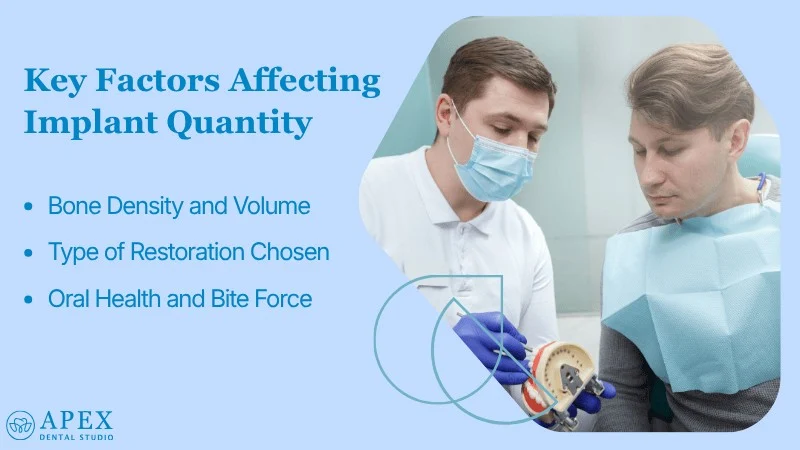
Several clinical details shape how many implants you need for full mouth restoration. Your bone structure, the type of prosthetic teeth you choose, and how your bite works all play a direct role.
Bone Density and Volume
Your bone density and bone volume determine how well implants can anchor into your jaw. Strong, thick bone can often support fewer implants because each post has solid support.
If you have bone loss, your dentist may suggest placing more implants to spread out pressure. In some cases, you may need bone grafting before implant surgery. Grafting builds up weak areas so the implant can fuse properly with the bone.
The upper jaw often has softer bone than the lower jaw. Because of this, you may need more implants on top than on the bottom to keep your prosthetic teeth stable.
A detailed scan helps measure bone height and width. This step guides the final implant plan and lowers the risk of failure.
Type of Restoration Chosen
The type of restoration you select directly affects implant count. A fixed full-arch bridge usually needs more implants than a removable denture.
For example, many full arches can be supported with 4 to 8 implants per jaw, depending on design and bone support. Options like All-on-4 full arch dental implants use four implants to hold a full set of prosthetic teeth. Other systems may use six or more for added strength.
Implant-supported bridges stay fixed in place and often require strategic spacing across the arch. Removable implant-supported dentures may use fewer implants because they rely partly on gum support.
Your choice affects cost, stability, and long-term wear. Fixed teeth feel more like natural teeth, but they may require more posts for proper balance.
Oral Health and Bite Force
Your current oral health plays a key role in planning. Healthy gums and controlled gum disease improve implant success and may reduce the need for extra support.
If you grind your teeth or have a strong bite force, your dentist may place more implants. Extra posts help spread out pressure and protect the prosthetic teeth from damage.
A balanced bite also matters. If your bite is uneven, certain areas may carry more force. More implants can help distribute that load evenly across the arch.
Your dentist evaluates gum health, jaw movement, and bite habits before surgery. This careful review ensures your implants can handle daily chewing without excess stress.
The Full Mouth Dental Implant Procedure: What to Expect
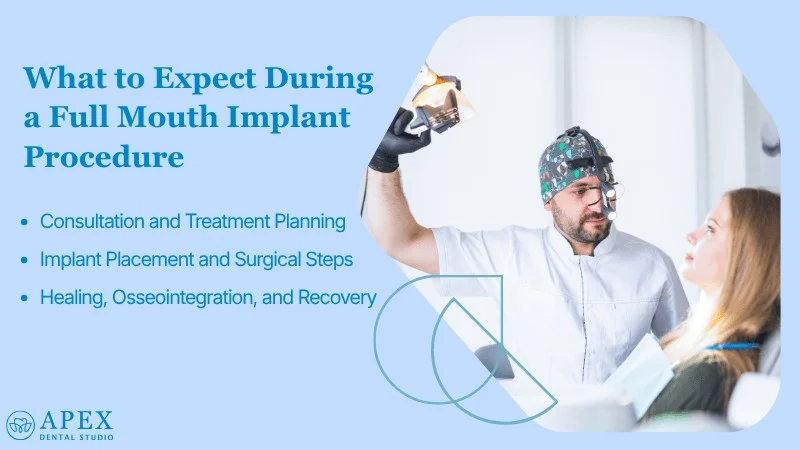
You will move through clear stages, from planning to surgery to healing. Each step focuses on placing implants securely and giving them time to bond with your jawbone.
Consultation and Treatment Planning
You start with a detailed exam from a dental implant specialist. The team reviews your medical history, checks your gums, and takes digital X-rays or 3D scans.
These images show your bone height, width, and density. They help your provider decide how many implants you need and where to place them.
Your specialist will explain options such as All-on-4 or All-on-6 full arch implants, which often use four to six implants per jaw to support a full set of teeth.
You will also review:
- Type of final teeth (fixed bridge or implant-supported denture)
- Need for extractions or bone grafting
- Sedation options for comfort
- Timeline and cost
A clear treatment plan helps you know what will happen at each visit.
Implant Placement and Surgical Steps
During the dental implant procedure, your provider places small titanium posts into your jawbone. This step is called implant placement.
You receive local anesthesia, and many offices offer sedation. Your specialist makes small openings in the gum and carefully positions each implant into the bone.
If you need tooth removal, the team may extract teeth during the same visit. In some cases, you may receive temporary teeth the same day, depending on your bone stability.
Key parts of implant surgery include:
- Precise drilling to protect nerves and sinuses
- Correct angling of implants for full arch support
- Tight placement to support healing
Most procedures take a few hours per arch. Mild swelling and soreness are common for several days.
Healing, Osseointegration, and Recovery
After surgery, your body begins osseointegration. This process allows the jawbone to fuse directly with the implant surface.
Osseointegration usually takes 3 to 6 months. During this time, you may wear temporary teeth and follow a soft food diet.
You will need to:
- Keep the area clean with gentle brushing
- Rinse as directed
- Attend follow-up visits
Your specialist checks healing and implant stability at each appointment. Once the implants fully bond with the bone, your provider attaches the final bridge or denture.
Strong healing during this phase supports long-term function and comfort.
Fixed vs. Removable Full Mouth Solutions
When you plan full mouth tooth replacement, you will choose between a fixed or removable design. Both use dental implants, but they differ in how they feel, how you clean them, and how many implants you may need.
Fixed Bridges and Hybrid Prosthetics
A fixed option stays in your mouth at all times. Your dentist secures implant-supported bridges or hybrid prosthetics directly to the implants with screws.
Most fixed full arch cases use 4 to 8 implants per arch, depending on your bone and bite force. Techniques such as All-on-4 full arch dental implants support a full set of teeth with four implants placed in key positions.
Key features:
- Feels closest to natural teeth
- Does not come out at night
- Spreads bite pressure across several implants
- Often requires good bone support
You brush and floss around the bridge daily. Your dentist removes it during maintenance visits when needed.
This option works well if you want strong chewing power and do not want removable dentures.
Removable Dentures Secured by Implants
Removable dentures attach to implants but still come out for cleaning. Your dentist may use 2 to 6 implants per arch, depending on the design and your goals.
Some systems use snap-on attachments. Others use a bar that the denture clips onto. These options improve stability compared to traditional dentures.
You can learn more about the number of implants used for full mouth tooth replacement and how they support different denture types.
Key features:
- Easier to clean since you remove them
- Often cost less than fixed bridges
- May feel less stable than fixed options
- Use fewer implants in many cases
This solution fits you well if you want better security than traditional removable dentures but prefer a lower-cost or less complex treatment.
Frequently Asked Questions
Most full mouth cases use 4 to 8 implants per arch, not one implant per tooth. The exact number depends on your bone strength, bite force, and whether you choose a fixed bridge or a removable denture.
What’s the typical number of implants required for a full upper denture?
Most full upper dentures need 4 to 6 implants for stable support.
The upper jaw has softer bone than the lower jaw, so your dentist may suggest more implants for better strength. Many patients choose systems that use four implants placed in key positions to hold a full arch securely.
Can you explain the difference between full arch reconstruction and All-on-4?
Full arch reconstruction is a broad term. It means replacing all teeth in your upper or lower jaw with implants and a fixed bridge.
All-on-4 is one specific method under that category. It uses four implants to support a full arch of teeth.
Other options, such as All-on-6, use six implants instead of four for added support.
Is there a standard for how many teeth are included in a full arch implant?
A full arch usually replaces 12 to 14 teeth on the top or bottom jaw.
Adults typically have 28 teeth total, not counting wisdom teeth. A full arch implant bridge restores the visible chewing teeth in one jaw, even though you do not need 12 to 14 separate implants to support them.
How many implants are generally necessary to support a lower denture?
A lower denture often needs 2 to 6 implants, depending on the design.
Two implants can hold a removable snap-in denture in place. Four or more implants can support a fixed bridge that stays in your mouth at all times.
The lower jaw has denser bone, so it often requires fewer implants than the upper jaw for good stability.
Does insurance typically cover the cost of full mouth dental implants?
Many dental insurance plans offer limited coverage for implants.
Some plans may cover part of the surgery or the denture portion, but not the full cost of implants and the final bridge. Medical insurance may help in rare cases, such as after trauma or disease.
You should review your policy and ask your provider for clear details about your benefits.
What should one expect in terms of pain during a full mouth implant procedure?
You will not feel pain during the procedure because your dentist uses local anesthesia or sedation.
After surgery, you can expect swelling and soreness for several days. Most people manage discomfort with prescribed or over-the-counter pain medicine.
You may also follow a soft food diet while your implants heal and bond with your jawbone.